


You've got a high-stakes moment coming up. A board meeting where you need to greenlight a major capital investment. Or a leadership offsite where you're asking your exec team to change direction on something they've already committed to. Or one of those rooms where three people hold the power and everyone else is just watching.
And the thing rattling around in your head is probably some version of: How do I walk in there and command the room?
I get it. That feeling of wanting to present with total authority. I've been there too.
But in all my years of working with CEOs and senior executives — and I mean people with real power, real stakes, real consequences — the ones who walk out with a yes aren't always the most polished presenters. They're not the most commanding in the room.
They just knew exactly what they walked in to do.
And that's the part most people skip.
They walk in hoping confidence shows up in the delivery, when confidence actually shows up in the decision they made before the meeting about what the conversation is there to do.
Just last week I had the privilege of participating in a conversation with Admiral William H. McRaven about leadership. He shared a piece of advice he got on his path to the top: "Before you decide or act, ask whether you could sit 'before the long green table' and clearly justify what you did to reasonable people in an official setting."
The "long green table" is a long boardroom table covered in green felt in the Navy, where personnel had to justify their decisions to senior officers. The point he made is that you earn the decision by everything you do before you find yourself in the moment of scrutiny.
The mistake: the thinking is muddy
You keep optimizing how you say things when the real issue is what you're saying.
Delivery is downstream of thinking. If the thinking is muddy, no amount of rehearsing will save it.
And the most common muddy thinking mistake I see at the C-suite level?
Walking into the boardroom without deciding what you need to walk out with.
This trips up the most brilliant executives. You understand the business case cold. You've stress-tested the numbers. You've been living inside this strategy for months. But knowing your material and knowing what job your deck is supposed to serve are two completely different things.
When that second part is missing, you can feel it . . .
You over-explain because you're trying to preempt every objection. The ask gets buried because you haven't committed to the outcome. Board members leave without clarity on what you actually need from them.
The fix happens in your intent, not your performance.
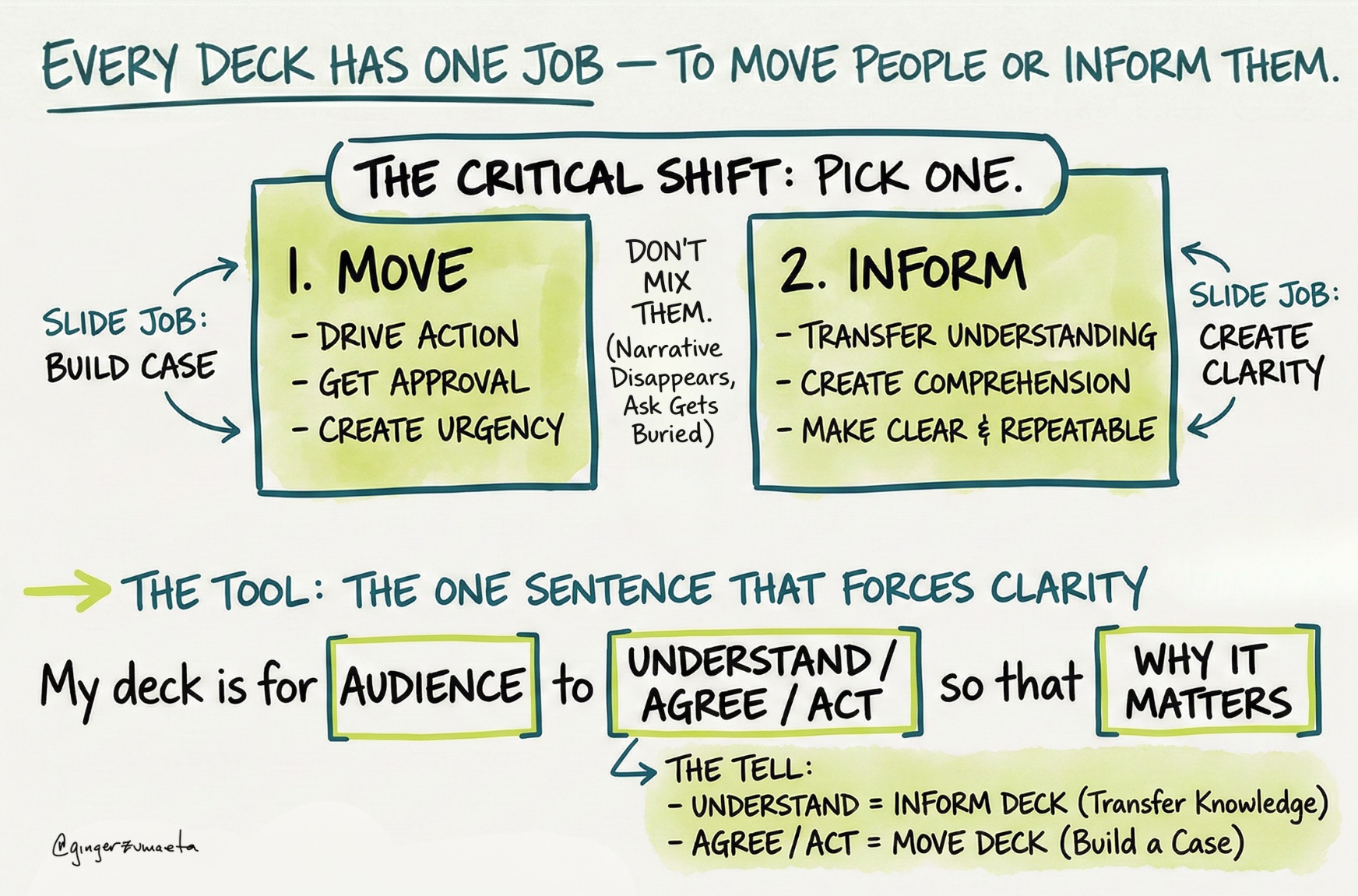
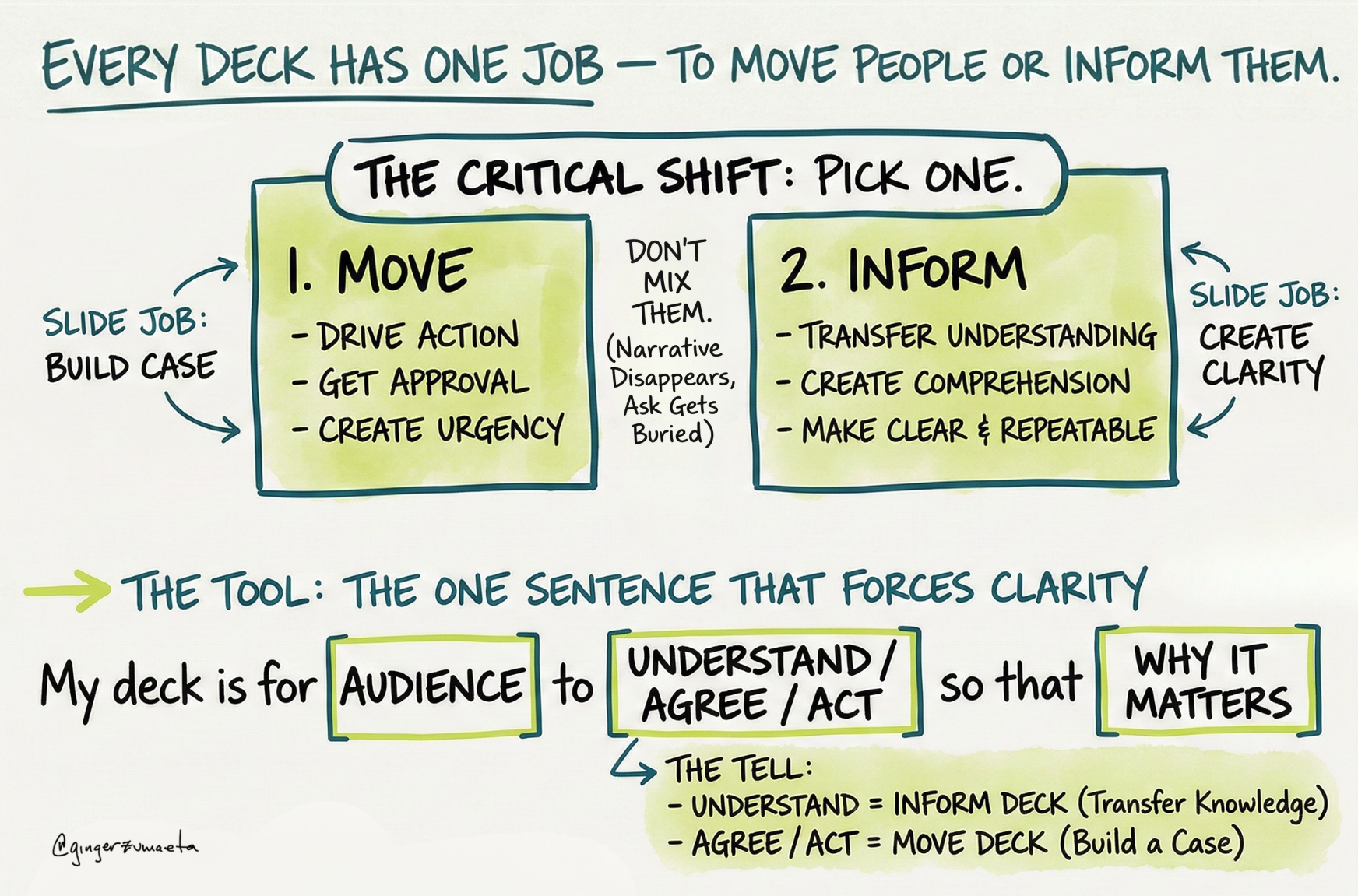
The shift: MOVE or INFORM. Pick one.
Before you open a single slide, your job is to answer one question.
Am I here to MOVE this board, or to INFORM them?
That's it. Pick one.
A MOVE deck exists to drive a decision.
Someone needs to approve the acquisition, fund the transformation, greenlight the reorganization, or change course on a strategic bet. Every slide has exactly one job: build the case or remove an objection. If a slide doesn't do one of those two things, it doesn't belong in the deck. I don't care how long your team spent on it.
An INFORM deck exists to transfer understanding.
Your board needs to walk away knowing something they didn't know when they walked in — clearly enough that they can act on it, repeat it, or use it to make future decisions without you in the room. It's not trying to create urgency. It's trying to create comprehension.
When you try to do both at once, you end up doing neither. The narrative disappears. The ask gets buried.
The tool: the one sentence that forces deck clarity
Here's the one question that forces clarity before you start building.
Finish this sentence:
My deck is for [AUDIENCE] to [UNDERSTAND / AGREE / ACT] so that [WHY IT MATTERS].
Notice the middle words. That's your tell.
Understand = Inform deck. You're transferring knowledge.
Agree / Act = Move deck. You're building a case for a decision. Your job is to make that easy.
Here's what fuzzy looks like: "This deck walks the board through our transformation progress."
No verb. No stakes. No job. Your board has no idea what you want from them… because you haven't decided.
Here's what clear looks like: "My deck is for the board to approve a $40M investment in our platform infrastructure so that we don't lose another year of competitive ground."
Now the deck has a job. Now you know what earns a slide. And now — critically — you know what to cut.
If you can't write this sentence before you open your slide tool, you haven't finished thinking.
Start here
Got your sentence? Now pull up the deck you're currently building.
If it's a MOVE deck, check your verb. Approve. Fund. Commit. Authorize. Greenlight. If you can't name what you need the room to do, you're not ready to build yet. Stay in the thinking.
If it's an INFORM deck, name the one thing your board needs to walk away knowing — clearly enough that they could brief someone else on it without you in the room.
Now audit every slide. One question per slide: Does this serve the job I just named?
If it builds the case — keep it. If it removes an objection — keep it. If it transfers the key understanding — keep it.
Everything else? Appendix or cut.
One more thing
If you want your leadership team to have a repeatable framework that actually moves decisions forward — that's exactly what the Get To The Point workshop is designed to do.
It's a full-day, in-person lab where your team works on a real deck they're actually building. They leave knowing how to construct a story that gets the room to yes.
And if you're the one personally staring down the high-stakes moment — a board meeting, an investor presentation, a strategic pivot you need executive buy-in on — that's what Narrative Coaching is for. It's 1:1 strategic support for the moments where the message has to land the first time. Get in touch
FAQS
Q: How do I know if my deck is supposed to move people or just inform them?
A: Start with the outcome. If the room needs to approve, fund, authorize, or change direction, it is a MOVE deck. If the goal is to transfer understanding so people leave clearer and better equipped, it is an INFORM deck.
Q: What is the fastest way to make a deck clearer before I build it?
A: Write one sentence that defines the job of the deck: who it is for, what they need to understand or do, and why that matters. That sentence forces you to choose between informing and driving a decision. Once that is clear, it becomes much easier to know what stays, what moves to the appendix, and what gets cut.
Q: What should every slide in a deck be doing?
A: In a MOVE deck, each slide should either build the case or remove an objection. In an INFORM deck, each slide should help transfer the one key understanding the audience needs to leave with. If a slide does neither, it is probably extra.


