


Heya big thinker!
We’re in a funny time right now, aren’t we? Let me venture a guess about your feelings regarding content generation and publishing.
Necessary evil.
As a proud Gen-Xer, I sit in an interesting seat. I started my television career pre-internet. I even launched the very first media website in my hometown of San Antonio at KMOL-TV (now WOAI).
My GM at the time asked, “Why?” Why should we try to stake a claim in this nascent whatever-it-was?
This was the early AOL days when you picked a door (a big-ass button) to go through and then . . . browsed.
Little did I know that in a few short years I’d be working alongside a bunch of other smart people at NBC transitioning us from analog to digital.
Then social was born. Then streaming.
And here we are.
The internet is a hungry beast whose appetite is never satisfied.
And so . . . content.
To “be visible” — to maintain some level of share of mind — you must publish. And your content has to tickle the bear immediately or the algorithm will make you disappear.
Now, for all of you with real expertise in things that matter, here’s the problem.
Your expertise is real, but your content pipeline is broken.
And here's the part that stings—AI was supposed to fix this!
You open ChatGPT. Type something like "Write a thought leadership Linkedin post that addresses managing through change from an enterprise healthcare POV."
TBH, that’s a better prompt than most will enter. Go ahead and try it. You’ll get back about 200 words of competent sounding stuff that is probably better than what you expected.
But it will also be forgettable.
Now you have to decide whether you’ll post it anyway because something is better than nothing.
But what will you do tomorrow??
The mistake: treating AI as the writer.
The hype cycle sold us a fantasy: Hand the machine a prompt. Get back thought leadership. Hit publish. Repeat.
But that's not how authority works.
The hard part of content was never the writing. The hard part is knowing what's worth saying, connecting it to what your audience actually struggles with, and packaging it so it travels without you in the room.
AI can't do that.
Because AI needs context.
Generating content from thin air produces exactly what you'd expect: thin generic content.
The shift: AI as the labor layer, not the brain.
Here's the reframe that changes everything.
Stop asking AI to think for you. Start using it to operationalize what you already know.
Most leaders are sitting on a goldmine of raw material—meeting insights, client breakthroughs, workshop moments, hallway conversations where they said something brilliant that no one captured. That material is scattered across calendars, Slack threads, call recordings, and memory.
The question is: Which of these things matter?
The work I’m doing with clients right now isn’t about using AI to generate.
That’s really surface level stuff.
What we’re leveraging AI for is to capture, categorize, filter, and repurpose the insights and stories that happen organically every day.
Think of it this way:
- You run a meeting and someone says something sharp about how your new onboarding experience is getting rave reviews from clients. That's a story kernel—an insight or anecdote with story potential.
- If your AI knows what it’s looking for, it can extract those kernels for you from transcripts, meeting notes, reports, etc., and remember them for reuse.
- Your kernels accumulate and become a LinkedIn post this week, a newsletter angle next month, and a slide in your next keynote.
The difference is the workflow that turns raw narrative supply into reusable assets.
This is story mining, and it needs to become an operational discipline. And when it sits on the rails of a messaging playbook, the organizations and leaders who build this muscle now won't just publish more. They'll publish better--because every piece of content traces back to something real and audience-aligned.
The framework: Build a Content Engine in 4 layers.
If you want to stop white-knuckling every piece of content and start building a pipeline that compounds, here's the architecture.
Layer 1: Capture.
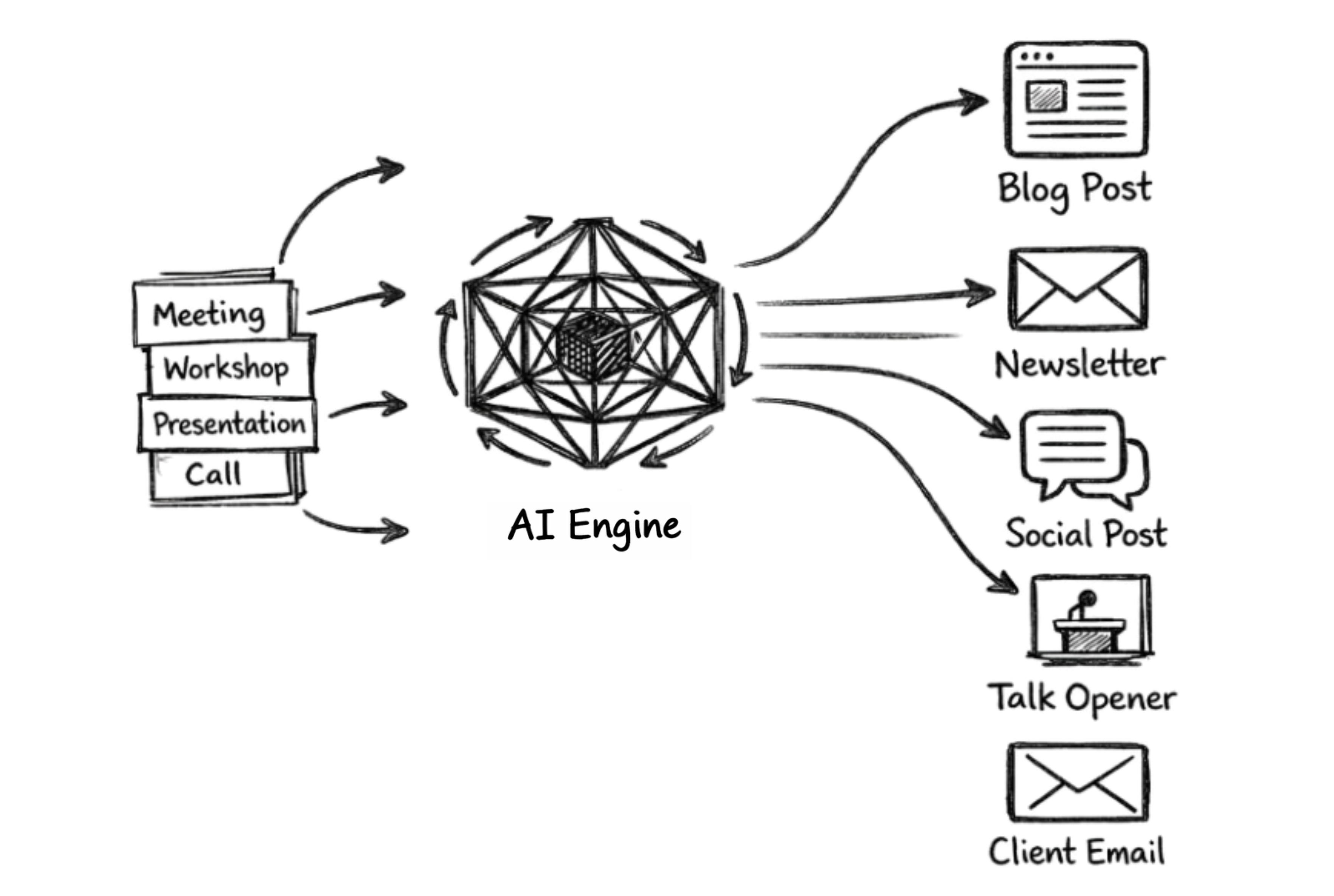
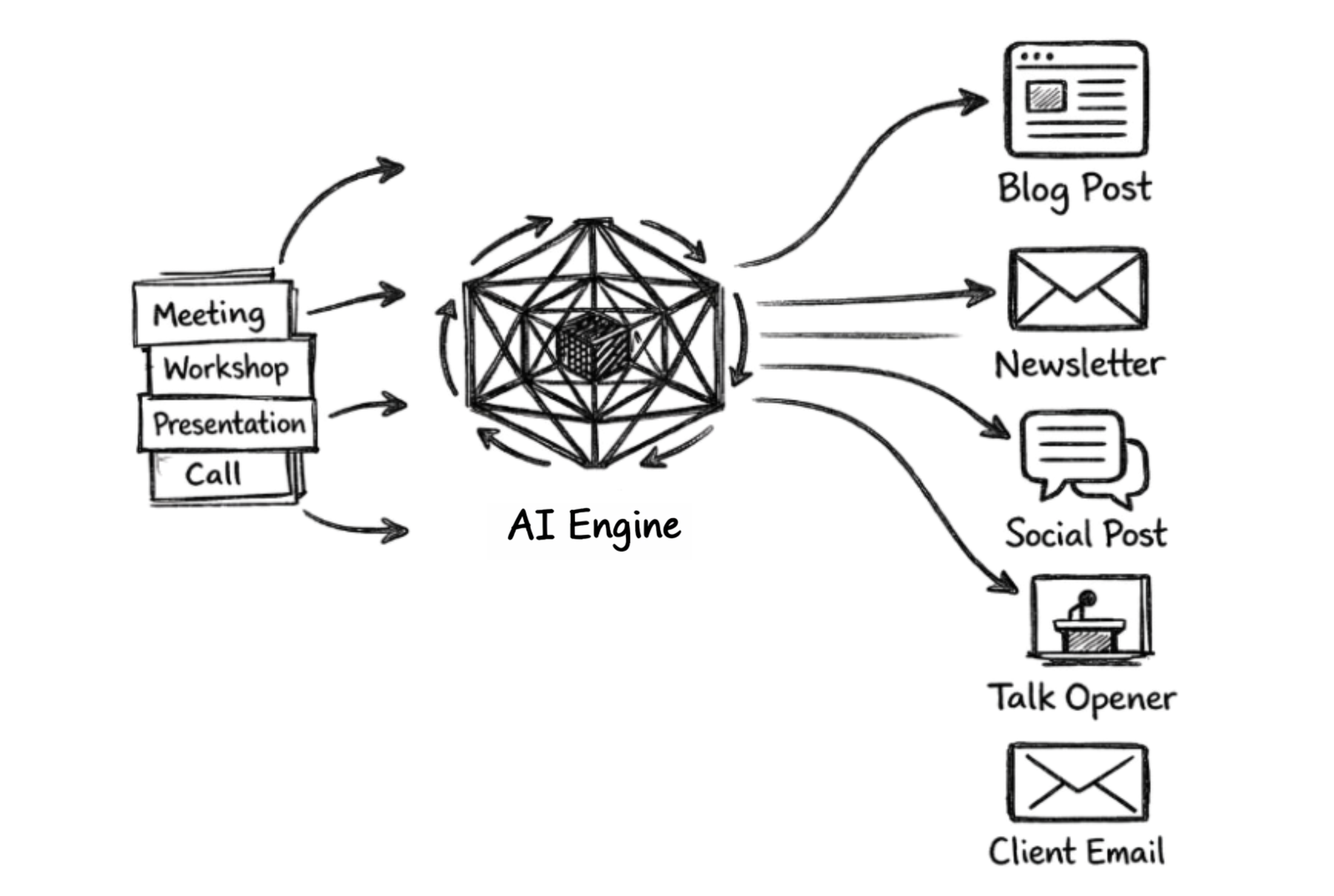
Set up a simple habit: after every meeting, workshop, or presentation, capture 2-3 raw insights. Not polished copy. Just the moment, the tension, the unexpected line that landed. AI transcription tools make this nearly free now.
Layer 2: Contextualize.
Tell your AI what matters to you. This is where AI earns its keep--pattern recognition across dozens of captured moments to surface what's worth developing.
Layer 3: Translate.
Turn a raw kernel into a finished asset. This is the only step most people try to do, and they try to do it from scratch every time. When you've done Layers 1 and 2, translation is fast because the hard thinking is already done.
Layer 4: Recirculate.
One insight isn't one post. It's a post, a newsletter section, a talk opener, a client email. The engine recycles your best thinking across formats and audiences so your ideas compound instead of evaporate.
Why this matters now.
You need to stop thinking of AI as your writer.
AI agents are rapidly becoming the default interface for getting work done—not just generating text. The cost of capture, tagging, and repurposing is dropping toward zero.
Very soon—and I mean VERY SOON—your knowledge base will sit on your own proprietary local infrastructure. You will finally be able to decouple your data from the brain.
When you separate the Intelligence from the Information, the bottleneck officially shifts.
It's no longer "We don't have time to create content."
It's "We haven't built the system to activate what we already know."
That is a solvable architectural problem. But it only works if you start building that knowledge base NOW.
The leaders who build this engine now—even a scrappy, imperfect version--will have a compounding advantage over the next 12 months. Not because they use better AI tools. Because they built the workflow that makes AI useful.
Start here.
You don't need a production team or a fancy tech stack. You (YES YOU!!) can experiment with three things this week:
- Record a handful of your calls this week and then feed them to an AI and ask it to extract insights and anecdotes. You’ll have to define what qualifies as an insight. At a minimum, tell the AI who your audience is, and what problem you solve for them. That's your first step. (HINT: If you have a messaging playbook, you just give it to AI and it will already know everything it needs.)
- Take the insights and anecdotes it generates and decide which of your customer benefits (your messaging pillars) each supports. What audience does this serve? What problem does it name? What should someone do differently after hearing it?
- Open up your AI and speak to it. In real spoken language, tell it you want to create a short email. A post. Or whatever. Tell it what message you want to convey. And then attach the insight or anecdote (your kernel) and tell it to incorporate that as a support point or proof point. Voila. You now have a message no one else could have created.
Of course I’m simplifying this a bit. But, turn this into a practice and you’ll start to see what’s possible.
One more thing.
If you want help designing a content engine that turns your expertise into a repeatable stream of enterprise-grade content—without the "content hamster wheel" . . .
Get in touch and let’s start a conversation.
FAQS
Q: What is a content engine and why does it matter?
A: A content engine is a repeatable system for capturing ideas, adding context, turning them into usable assets, and reusing them across formats. It matters because most experts do not have an idea problem. They have a workflow problem.
Q: What is story mining in content marketing?
A: Story mining is the practice of pulling usable insights, anecdotes, and proof points out of real conversations, meetings, workshops, and day-to-day work. Instead of forcing content from scratch every time, you build from material that already happened. That makes the content more credible, more specific, and much easier to repurpose.
Q: What is the fastest way to improve content without creating everything from scratch?
A: Start by capturing what your team is already saying in meetings, calls, and presentations. Those moments often contain the strongest ideas, but they disappear because nobody saves them. Once you collect them consistently, AI becomes much more useful because it has something real to work with.


