


Hiya big thinker,
Here's the kind of thing I hear in workshops: "It's a multi-modal enzyme binding platform that modulates inflammatory pathways." I ask for the third-grade version and it turns into: "It reduces inflammation and pain."
That's the actual value. One sentence. And it was buried under a fog of words.
This happens in every workshop. Brilliant people. Strong ideas. And an explanation so packed with jargon and methodology that the point -- the real point, the one that would make someone lean forward -- never gets airtime.
It's the most expensive communication habit in leadership. And the smartest people have it the worst.
Why smart leaders lose the room
The smarter you are, the more likely you are to over-explain. And the more you over-explain, the less anyone hears.
Let’s be direct about where this comes from, because I think we dance around it too much.
It's fear and ego. Fear that a simpler message won't sound credible. Ego that stripping things down somehow diminishes your intelligence. I get it -- I really do. These are human impulses. They're also liabilities, because both of them prioritize how you feel over whether your audience actually receives the message.
While you're proving how much you know, the person across the table is scanning for exactly three things:
- Is this relevant to me right now?
- Can it help me?
- Can it hurt me?
That's it. Strategic relevance. Business value. Risk exposure.
If you don't hit those fast, you've lost them. There is an abundance of information and a scarcity of attention -- and patience is not a resource your stakeholders have in surplus. I promise you.
Simplicity is the proof of mastery.
Einstein nailed it: “If you can't explain it simply, you don't understand it well enough.” (My favorite quote ever btw!)
Stripping an idea to its sharpest version means knowing your material so deeply that you can let go of 90% of it and trust the remaining 10% to carry the weight.
That’s how you know the thinking is actually done.
That takes practice. And most leaders haven't had a reason to build that muscle.
The thing you almost didn't say because it sounded too direct? That's the hit. That's the line that leaves a mark. The stronger the idea, the less it needs around it.
Build your one-liner
I give every client the same challenge.
One sentence. That's it.
"I help [WHO] achieve [OUTCOME] by [HOW]."
Sounds deceptively easy. It is not. Because every word has to earn its place.
WHO -- and be specific. "B2B SaaS startups battling churn" is specific. "B2B companies" is vague. Name them so precisely that the right person hears it and thinks that's me.
OUTCOME -- the result they actually lose sleep over. Revenue growth, faster decisions, fewer lost deals -- whatever the thing is that would make their quarter.
HOW -- no jargon. If your mother wouldn't understand the verb, rewrite it. "pinpointing where the messaging is failing" works. "leveraging synergistic alignment capabilities" is... well, you know exactly what it is.
Sooooo many leaders skip this step, and then wonder why every meeting starts with ten minutes of throat-clearing before anyone understands what they're proposing. The one-liner forces you to make choices. You can't be everything to everyone in one sentence. That's the point. The constraint is the tool.
Pro Tip: the more specific, the more plain language . . . the better. You’ll resist most with the WHO. Resist that resistance!
Keep compressing until it's uncomfortable. Until you're convinced you've cut too much. That discomfort? That's the signal you've arrived at the core.
The leaders with the discipline to simplify are going to have a serious edge. Complexity is the enemy of decision-making. That's always been true. Right now, it's urgent.
What you can do today
Run your message through the Fog Filter. Cut the clutter until only the bone is left.
Test 1: Can you explain what you do in one sentence? If you can't, you're in the fog. Cut the clutter. Go back to the one-liner and keep compressing until it passes.
Test 2: Would a non-expert understand it immediately? Say it to someone who doesn't live inside your work every day. If they are confused, it's too complex. Use simpler words. Drop the jargon.
Test 3: Does it pass the "So what?" test? Say your pitch out loud and be honest -- does it answer "so what?" If your message sounds like it belongs on a corporate values poster, you're stuck in features and fog. Rewrite until the benefit is unmistakable.
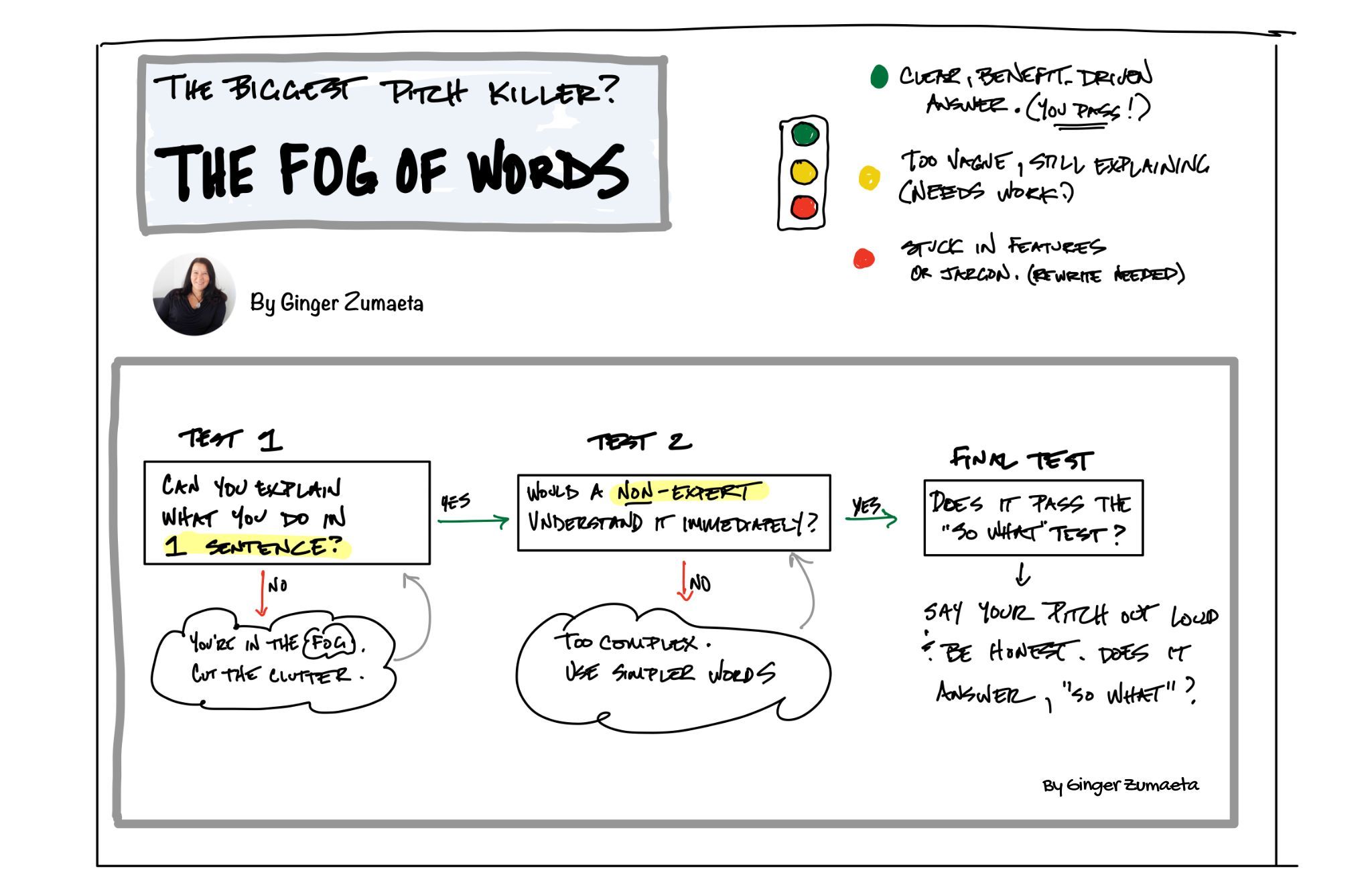
Green light: clear, benefit-driven, ready to go. Yellow: too vague, still explaining -- needs work. Red: stuck in features or jargon. Full rewrite.
This is the work I do every day -- helping leaders strip their message down to the sentence that actually moves the room. If you want to talk about what that looks like, let's talk.


