


Hiya smartypants!
You have two reputations.
The one you think you’re projecting, based on real bona fides.
And the one the room is actually receiving.
You've spent years building the first one. The expertise, the judgment, the track record of making hard calls and being right often enough that people trust your instincts. That part is real. You've earned it. You get it done. Nobody's questioning whether you belong at the table.
We like to think getting ahead runs on merit. Do good work, get recognized. But it's never quite that simple.
Back in the '80s, a guy named Harvey Coleman went looking for what actually drives whether you move on up (sorry, couldn’t help the ‘80 Jeffersons reference). He broke it into three things, a model he called PIE:
→ Performance: are you good at the work.
→ Image: how you're perceived.
→ Exposure: how many of the right people have actually seen you in action.
Naturally, you'd bet on performance being the thing that matters most. Do a killer job, move on up.
Nope.
Coleman's numbers say performance is about 10% of it. TEN!!! The thing you've spent your entire career obsessing over is one-tenth of the equation.
Don’t get me wrong. The 10% matters — it’s table stakes. But jeez, as a middle-class Latina from San Antonio, I thought it was ALL about performance. The idea of the American Dream is founded on hard work and grit. GSD. Right?!? Sigh.
In reality, the other 90% is everything that happens in other people's heads. Image runs around 30%. And exposure is a whopping 60%. (Harvey Coleman, Empowering Yourself)
It's a total gut-punch. The work matters. Of course it does. But the work alone is not what people experience in the room.
They experience how clearly you think. How calmly you lead. How well you listen. How you handle pressure. How you make decisions when things get messy.
That’s presence.
And it's not a small thing. More than half of leaders say being perceived as having executive presence matters more than their actual technical qualifications for promotion. (Harvard Business Review)
What got you here won't get you there, as Marshall Goldsmith put it.
So the question is how you close the gap. You stop treating presence as some mysterious, unnameable quality and start looking at the mechanics of how it actually works.
Executive presence is your ability to make people trust you and follow your lead. Nothing mystical about it. It's in how you show up.
Two forces, working together
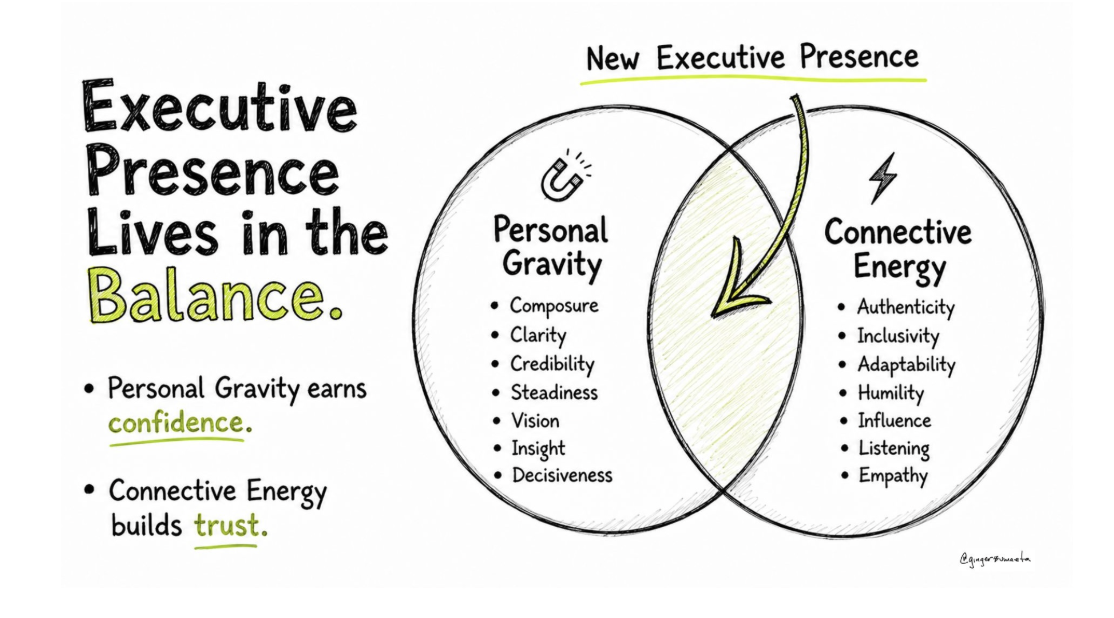
Executive Presence splits into two forces. Personal Gravity and Connective Energy.
Gravity is your substance and credibility as a leader. What you are. It earns you confidence.
Energy is your ability to connect with, influence, and inspire others. What you do with others. It builds trust.
All gravity, no energy: you're the person everyone respects and nobody wants in the room. All energy, no gravity: you're well-liked and quietly unpromotable.
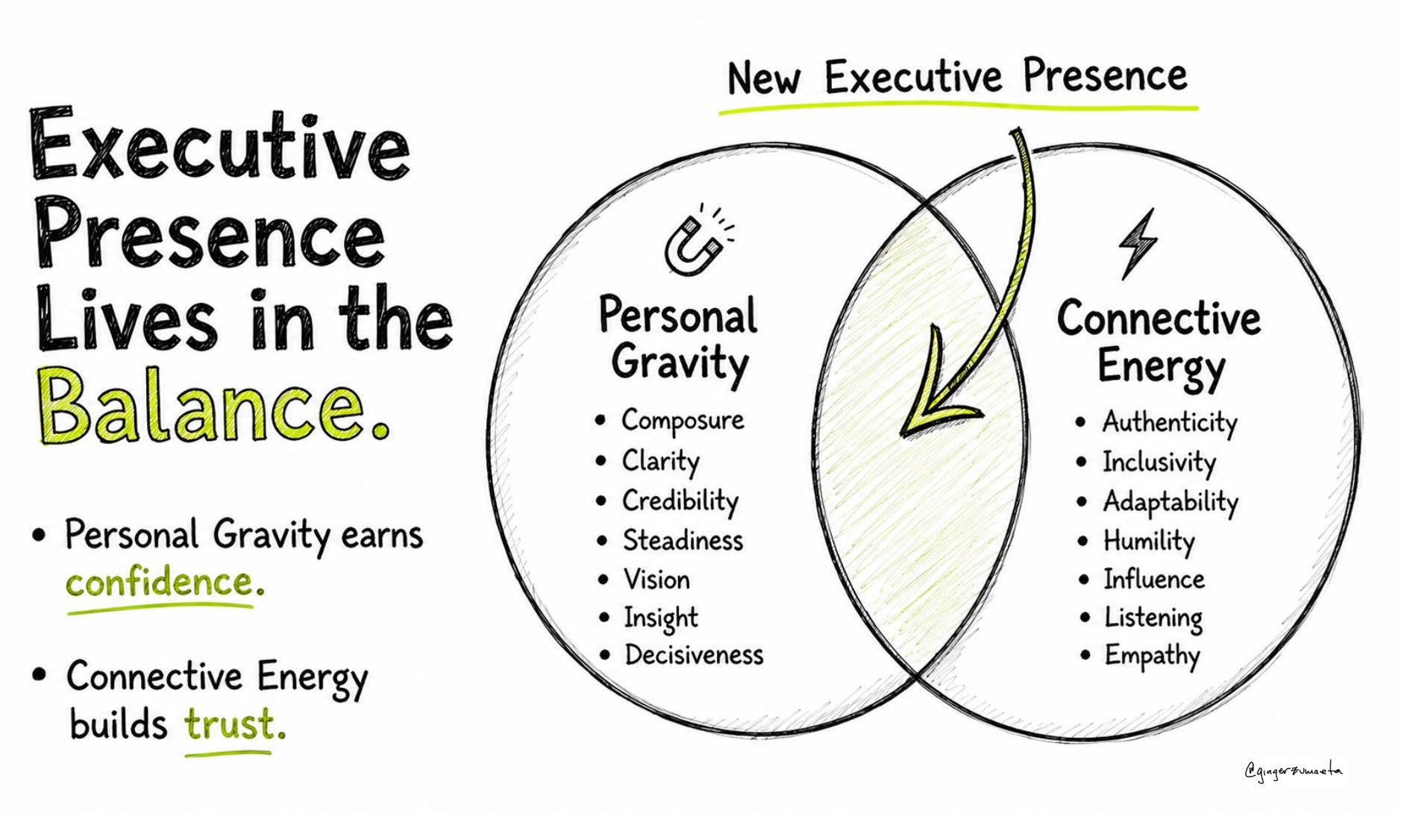
Executive presence lives in the balance. Right where the two overlap.
You can feel it when you're wrecking your gravity. Rambling. Hedging. Looking disorganized. You hear yourself losing the audience in real time.
The energy killers are sneakier. Going silent. Getting defensive. Interrupting. Checking out. You never catch these, because from the inside every one of them feels completely reasonable.
This is not a personality problem!! (I cannot stress this enough)
It's not a "you either have it or you don't" situation, no matter how many people talk about it like it is. That's the old X factor myth, and it's wrong.
Presence is behavior. Stuff you do. And stuff you do can be looked at, measured, tweaked, practiced, gotten better at. Like anything else.
It's gravity and energy, sitting in balance. Both of them undermine-able (the killers, remember)—but also both of them buildable. On purpose. By you.
This is about amplifying your impact. It's about taking the you that already exists—the smart one, the one who's earned the seat, the one who's been doing the work for years—and just getting it to land.
Same you. Just clearer.
Start here
Don’t try to reinvent your whole leadership style. Start smaller.
→ Pick one Personal Gravity behavior. Your substance side—composure, clarity, credibility, decisiveness. Choose the one that'd move the needle most, then turn it into a concrete action you can take in a real meeting. A specific, do-able thing. Example: If it's clarity → lead with your recommendation, then the reasoning.
→ Pick one Connective Energy behavior. How the room experiences you — listening, humility, inclusivity, empathy. Same move. Name the one that needs work, and define exactly what you'll do differently. Example: If it's listening → let people finish before you respond, even when you know where they're headed.
→ Then find a place to practice it. A routine standup, a casual one-on-one, anywhere you can test it. The point is reps, not perfection.
Technical brilliance without presence makes you a great contributor. Technical brilliance with it makes you a leader.
One caveat
Presence isn't judged in a vacuum. It's read through a filter, and the filter isn't neutral. The same behavior that reads as "confident" in one person reads as "arrogant" in another. Often the only difference is who's doing it.
So it cuts both ways. If you're being judged through that filter, a bad read isn't proof you lack presence. And if you're the one judging, widen the lens. Don't ask whether someone shows up the way you would. Ask whether they're credible and whether they connect.
Presence is a skill, not a stereotype. Practice yours. And give everyone else the same room to practice theirs.
If any of this is rattling around in your head — or you've got people on your team who are sharp on paper but somehow not landing in the room — hit reply.
It's what our New Executive Presence workshop is built for: a half-day where leaders map their own gravity and energy, see how the room actually reads them, and practice the behaviors that close the gap.


